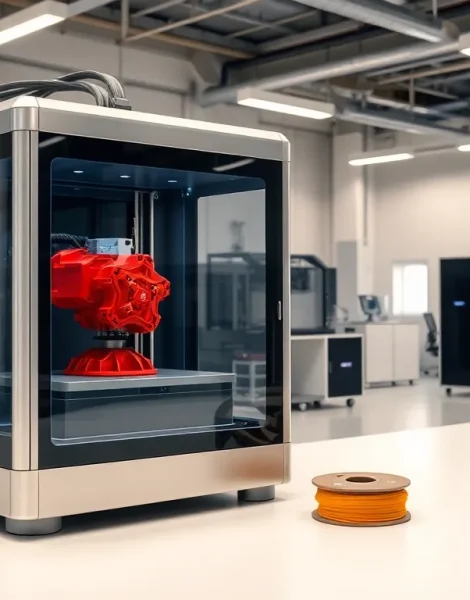
The 3D printing trends 2026 landscape looks dramatically different from just a few years ago. Manufacturers, healthcare providers, and hobbyists alike are watching this space closely, and for good reason. The technology has matured past its “cool but impractical” phase and entered an era of genuine utility.
This year promises faster machines, smarter software, and materials that don’t trash the planet. Whether someone runs a small business or works in a research lab, the shifts happening now will shape how products get made for decades. Here’s what’s actually changing and why it matters.
Table of Contents
ToggleKey Takeaways
- 3D printing trends 2026 highlight major advances in multi-material and high-speed printing, cutting production time by up to 80% compared to 2023 models.
- AI integration now automates design optimization, real-time quality control, and post-processing, making professional-grade 3D printing accessible to small businesses.
- Sustainable materials like biodegradable filaments and closed-loop recycling are reducing environmental impact and raw material consumption by up to 30%.
- Medical and bioprinting applications have expanded to include custom implants, skin grafts, same-day dental devices, and personalized pharmaceutical manufacturing.
- Consumer 3D printers under $300 and online service bureaus are democratizing manufacturing for hobbyists, educators, and small business owners.
- The 3D printing trends 2026 landscape shows the technology has moved beyond novelty into practical, everyday utility across industries.
Advancements in Multi-Material and High-Speed Printing
Speed and versatility have long been the twin bottlenecks of 3D printing. In 2026, both are getting serious upgrades.
Multi-material printing now allows machines to combine rigid plastics, flexible polymers, and conductive inks in a single build. A drone manufacturer, for example, can print a complete housing with embedded circuits and shock-absorbing components, no assembly required. This cuts production time and eliminates weak points where parts typically join.
High-speed printing has also accelerated. Some industrial systems now complete jobs 5 to 10 times faster than 2023 models. The secret? Better laser arrays, optimized resin formulations, and improved thermal management. A part that took eight hours now takes under two.
These 3D printing trends affect more than factories. Dental labs print crowns while patients wait. Automotive prototypers iterate designs in days, not weeks. The gap between “idea” and “physical object” keeps shrinking.
Multi-material capabilities also reduce waste. Instead of printing multiple single-material parts and combining them, manufacturers create finished goods directly. Fewer steps mean fewer errors, less scrap, and lower costs.
AI Integration and Automated Design Optimization
Artificial intelligence has become a practical tool in 3D printing workflows, not just a buzzword. In 2026, AI handles tasks that used to require hours of human input.
Generative design software takes a set of constraints, weight limits, stress tolerances, material budgets, and produces optimized geometries automatically. Engineers describe what they need: the software figures out how to build it. The results often look organic and strange, but they outperform traditional designs in strength-to-weight ratios.
AI also monitors print jobs in real time. Cameras and sensors detect layer defects, warping, or nozzle clogs. The system pauses, corrects, and resumes, sometimes before a human operator notices the problem. This predictive quality control saves materials and prevents failed builds.
3D printing trends 2026 show AI integration extending to post-processing too. Automated systems sand, cure, and inspect parts with minimal human involvement. A factory running overnight can produce finished goods ready for shipping by morning.
Small businesses benefit here as well. Cloud-based design tools with built-in AI make professional-grade optimization accessible to anyone with an internet connection. The barrier to entry keeps dropping.
Sustainable Materials and Eco-Friendly Manufacturing
Environmental concerns have pushed the 3D printing industry toward greener practices. 2026 marks a turning point for sustainable materials.
Biodegradable filaments made from corn starch, algae, and recycled plastics now rival traditional polymers in performance. They print cleanly, hold detail well, and break down responsibly at end-of-life. Major brands have committed to phasing out petroleum-based materials for consumer products.
Recycling loops are closing too. Some facilities grind failed prints and support structures back into usable filament. This circular approach reduces raw material consumption by up to 30% in high-volume operations.
3D printing itself remains inherently less wasteful than subtractive manufacturing. A CNC machine carves a part from a solid block, discarding 70% or more as chips. A 3D printer builds only what’s needed, layer by layer. That efficiency advantage grows as material costs rise.
Carbon-neutral printing operations have also emerged. Solar-powered facilities and energy-efficient machines help companies meet sustainability targets. Consumers increasingly ask where products come from and how they’re made, 3D printing trends 2026 provide better answers than traditional factories.
Growth in Medical and Bioprinting Applications
Healthcare continues to be one of the most promising frontiers for 3D printing. In 2026, applications extend well beyond prototypes and visual aids.
Custom implants, titanium hip joints, spinal cages, cranial plates, are now printed to match individual patient anatomy. Surgeons upload CT scans, and the system produces a perfect fit. Recovery times improve because the body accepts these personalized devices more readily.
Bioprinting has advanced from experimental to practical. Labs print skin grafts for burn victims, cartilage for joint repair, and vascular structures for surgical planning. Fully functional organs remain years away, but the building blocks are falling into place.
Dental applications have exploded. Clear aligners, surgical guides, and dentures come off printers the same day. Patients get faster treatment: practitioners handle more cases with less labor.
3D printing trends 2026 also show growth in pharmaceutical manufacturing. Some pharmacies now print pills with customized dosages and release profiles. A patient needing multiple medications might receive a single combined tablet printed specifically for their regimen.
Regulatory bodies have caught up with the technology. Clearer approval pathways encourage investment and accelerate adoption in clinical settings.
Expanding Accessibility for Consumers and Small Businesses
Not long ago, quality 3D printers cost tens of thousands of dollars. That’s changed.
Reliable consumer machines now sell for under $300. They print with decent speed, acceptable resolution, and minimal fuss. A hobbyist can produce replacement parts, custom enclosures, or creative projects at home.
Small businesses have taken notice. Custom product makers, jewelers, toy designers, specialty tool manufacturers, use desktop printers for prototyping and short-run production. They skip expensive tooling and minimum order quantities that once blocked entry to the market.
3D printing trends 2026 show service bureaus expanding too. Online platforms let anyone upload a design, choose a material, and receive a finished part in days. No equipment purchase required.
Education has embraced the technology. Schools teach design thinking and manufacturing basics through hands-on printing projects. Students graduate with practical skills that translate directly to modern workplaces.
User communities share designs freely. Open-source repositories contain millions of printable objects, from practical household fixes to elaborate art pieces. The collective knowledge base grows daily, lowering the learning curve for newcomers.
This democratization changes who gets to make things. 3D printing isn’t just for engineers and industrial designers anymore. It belongs to anyone with an idea.