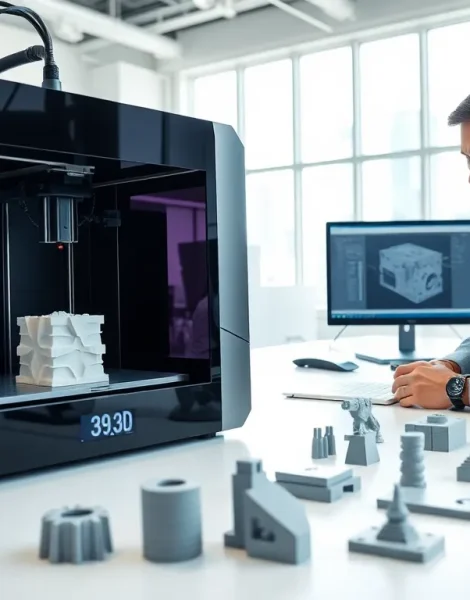
Top 3D printing has transformed from a niche hobby into a mainstream manufacturing method. In 2025, the technology continues to advance at a rapid pace. Faster print speeds, improved materials, and lower costs have made 3D printing accessible to everyone from hobbyists to large corporations.
This guide covers the most popular 3D printing technologies available today. It also examines the best printers for different skill levels, the industries driving adoption, and practical tips for choosing the right machine. Whether someone wants to print custom parts at home or scale up production for a business, understanding these trends is essential.
Table of Contents
ToggleKey Takeaways
- Top 3D printing technologies in 2025 include FDM for beginners, SLA for detailed models, and SLS/MJF for functional production parts.
- FDM printers like the Creality Ender-3 V3 and Bambu Lab A1 Mini offer affordable, beginner-friendly options under $300.
- Healthcare, aerospace, and automotive industries lead in 3D printing adoption for custom parts, lightweight components, and rapid prototyping.
- When choosing a top 3D printing machine, define your use case, set a budget, and verify material compatibility before purchasing.
- Professional-grade printers like the Formlabs Form 4 and HP Jet Fusion 5200 enable production-scale manufacturing with consistent quality.
- Test different 3D printing technologies at makerspaces or libraries to find the best fit for your needs before committing to a purchase.
Most Popular 3D Printing Technologies
Several top 3D printing technologies dominate the market in 2025. Each method offers distinct advantages depending on the application.
Fused Deposition Modeling (FDM) remains the most widely used technology. FDM printers melt plastic filament and deposit it layer by layer. They’re affordable, easy to operate, and compatible with many materials like PLA, ABS, and PETG. Most consumer-grade 3D printers use FDM.
Stereolithography (SLA) uses UV light to cure liquid resin into solid objects. SLA produces parts with exceptional detail and smooth surfaces. It’s popular for jewelry, dental models, and prototypes requiring fine features.
Selective Laser Sintering (SLS) fuses powdered materials using a laser. This technology creates strong, functional parts without support structures. SLS works well for aerospace components, medical devices, and end-use products.
Multi Jet Fusion (MJF) from HP has gained traction in industrial settings. MJF produces parts quickly with consistent mechanical properties. Many manufacturers choose MJF for batch production runs.
Direct Metal Laser Sintering (DMLS) handles metal printing for high-performance applications. Industries like aerospace and automotive rely on DMLS for lightweight, complex metal components.
Each of these top 3D printing methods serves specific needs. FDM suits beginners and rapid prototyping. SLA excels at detailed models. SLS and MJF handle functional production parts. DMLS addresses metal manufacturing requirements.
Best 3D Printers for Different Skill Levels
Choosing a 3D printer depends heavily on experience level and intended use. Here’s a breakdown of top 3D printing machines for beginners and professionals.
Beginner-Friendly Options
New users should prioritize ease of setup and reliable performance. The Bambu Lab A1 Mini offers excellent print quality at an accessible price point. It includes automatic bed leveling and a user-friendly interface.
The Creality Ender-3 V3 continues to be a favorite among hobbyists. It costs under $300 and has a massive online community for support. Spare parts and upgrades are readily available.
Prusa MK4 delivers consistent results with minimal calibration. Prusa’s customer support and documentation make troubleshooting straightforward. It’s a solid investment for anyone serious about learning 3D printing.
For resin printing, the Elegoo Saturn 4 Ultra provides high-resolution output at a reasonable cost. Beginners interested in detailed miniatures or jewelry often start here.
Professional-Grade Machines
Professional users need speed, precision, and material flexibility. The Formlabs Form 4 sets the standard for desktop SLA printing in professional environments. Dental labs, engineering firms, and product designers rely on its accuracy.
Markforged X7 prints with continuous carbon fiber reinforcement. Parts rival the strength of aluminum. It’s used for tooling, fixtures, and functional prototypes.
The HP Jet Fusion 5200 handles production-scale manufacturing. Companies print thousands of identical parts with consistent quality. It’s a top 3D printing solution for businesses moving beyond prototyping.
Raise3D Pro3 Plus offers a large build volume and industrial reliability. It supports multiple materials and operates 24/7 in production settings.
Leading Industries Using 3D Printing
Top 3D printing adoption spans numerous industries. Each sector leverages the technology differently based on its specific requirements.
Healthcare leads in 3D printing innovation. Surgeons use patient-specific anatomical models for surgical planning. Dental labs produce crowns, aligners, and implants in-house. Prosthetics manufacturers create custom limbs faster and cheaper than traditional methods. Bioprinting research continues to advance toward functional organ tissue.
Aerospace relies on 3D printing for lightweight components. Companies like SpaceX and Boeing print rocket engine parts and aircraft brackets. Weight reduction directly translates to fuel savings and improved performance.
Automotive manufacturers use 3D printing for prototyping and tooling. Ford, BMW, and General Motors print custom jigs, fixtures, and even some end-use parts. Electric vehicle startups especially benefit from rapid iteration capabilities.
Consumer goods companies print everything from eyewear to footwear. Adidas produces midsoles using 3D printing technology. Custom hearing aids are now almost exclusively 3D printed.
Construction has emerged as a growing sector. Large-scale concrete printers build homes in days rather than months. This approach addresses housing shortages and reduces construction waste.
Education institutions incorporate 3D printing into STEM curricula. Students learn design thinking and manufacturing principles through hands-on projects. Many schools now have dedicated maker spaces with multiple printers.
How to Choose the Right 3D Printer
Selecting a top 3D printing machine requires careful consideration of several factors. Here’s what matters most.
Define the primary use case. Hobbyists making figurines have different needs than engineers prototyping functional parts. Start by listing what you’ll actually print.
Set a realistic budget. Entry-level FDM printers start around $200. Professional SLA machines cost $3,000 to $10,000. Industrial systems run $50,000 and up. Factor in ongoing costs for materials, maintenance, and replacement parts.
Consider build volume. Larger prints require larger machines. But bigger isn’t always better, large printers take up space and cost more. Match the build volume to actual project requirements.
Evaluate material compatibility. FDM handles standard plastics. SLA works with specialized resins. Some applications demand flexible materials, high-temperature plastics, or metal. Verify the printer supports needed materials.
Research reliability and support. Read user reviews about long-term performance. Check if the manufacturer provides responsive customer service. Look for active online communities where users share tips and troubleshooting advice.
Think about software and workflow. Most printers require slicing software to prepare files. Some have proprietary ecosystems while others work with open-source tools. Consider how the printer fits into existing design workflows.
Test before committing. Many makerspaces and libraries offer 3D printing access. Hands-on experience with different technologies helps clarify preferences before making a purchase.